
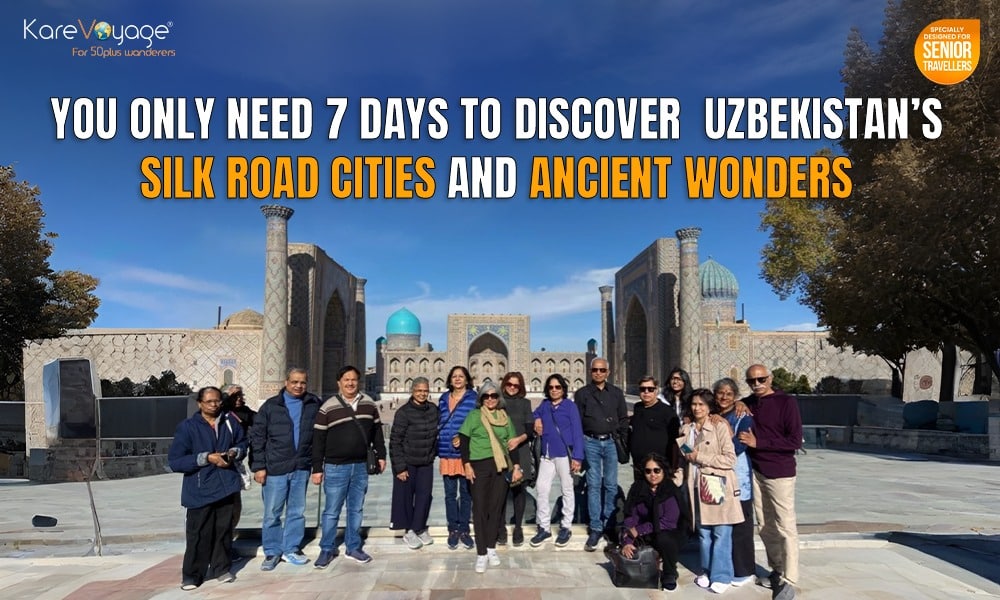
Seven days may sound short for a country whose history stretches across thousands of years. Yet Uzbekistan has a rather interesting advantage. Some of its richest Silk Road history, grandest monuments & most fascinating cultural experiences are concentrated in three cities – Tashkent, Samarkand & Bukhara. Collectively, all of them present centuries of trade, Timurid rule, Islamic scholarship, architecture, crafts & everyday Uzbek life into one journey.
The best part is that you do not need weeks to experience these highlights. A well planned route can connect all 3 cities within seven days with efficient rail travel helping you spend more time exploring and less time on the road. For travellers considering senior citizen tours from India to Uzbekistan, thoughtful planning can also make the journey comfortable and well paced.
So, how can seven days cover so much? Let’s look at the route and the reasons that make it possible:-
Why Uzbekistan is ideal for a 7 day silk road journey
‘The Silk Road was’ not a single road. It was a vast network of routes that connected – traders, travellers, scholars, craftsmen and rulers – across Asia, the Middle East and Europe. Uzbekistan held an important place along these routes & its historic cities still show the influence of this rich past.
The best part is how much history can be experienced across a relatively short route. Tashkent, Samarkand and Bukhara each represent a different chapter of Uzbekistan’s story. ‘Tashkent’ brings together Islamic heritage, Soviet history and modern Uzbek life. ‘Samarkand’ reflects the power and ambition of the Timurid era – while ‘Bukhara’ preserves the character of an old trading, religious and intellectual centre.
Seven days can therefore cover a surprisingly rich part of the Silk Road story without requiring travellers to crisscross the entire country. High speed trains connect Tashkent with Samarkand & Bukhara making the journey much more practical than it would have been in the past.
The trick is to choose the right cities & arrange them perfectly. When the route is planned well – less time is spent travelling between destinations & more time remains for exploring
How Tashkent, Samarkand and Bukhara fit into a 7-day Uzbekistan journey
Tashkent:-
Tashkent may not look like the Uzbekistan most people imagine at first. Wide avenues, modern buildings & Soviet-era structures dominate much of the city but its story goes far deeper than its present-day appearance suggests.
Much of the city was rebuilt after the 1966 earthquake – bringing large Soviet-style public buildings and planned neighbourhoods into the capital. Today, those structures sit alongside mosques, traditional markets, historic religious complexes and newer parts of the city. A walk through Tashkent can therefore take you through several very different periods of Uzbek history within a surprisingly short distance:-
- The Monument of Courage helps put this transformation into perspective. Built to commemorate the 1966 earthquake, the monument is more than a landmark. It helps explain why parts of Tashkent look so different from the older cities of Samarkand and Bukhara
- The Tashkent Metro adds another unexpected side to the Several stations feature marble interiors, chandeliers, decorative artwork and designs inspired by different themes. A short metro ride can become an unusual way to see the city’s Soviet architectural heritage without spending hours visiting separate buildings
- The historical picture changes again around the Khast Imam Complex and Kukeldash Madrasa. Religious scholarship, Islamic architecture and traditional craftsmanship become more visible here. The Museum of Applied Arts adds to the experience through Uzbek textiles, ceramics, woodwork and other forms of decorative art
That mix is precisely why Tashkent deserves more than a quick arrival and departure stop. Two days give travellers enough time to understand the different layers that shaped modern Uzbekistan before moving towards the grander historical centres of the Silk Road.
Samarkand:-
Samarkand brings a completely different scale to the journey. The city is often associated with the Silk Road but its history goes far beyond the famous blue-tiled monuments seen in photographs:-
- Ancient Samarkand grew around Afrasiab, an archaeological site whose history reaches back to the 7th century BCE. Centuries later, the city entered another remarkable phase under the Timurids – when Amir Timur and his successors transformed Samarkand into a major centre of power, architecture, science and That difference between ancient Samarkand and Timurid Samarkand is worth understanding before visiting. The monuments around the modern city represent different periods, so seeing them together reveals how the city continued to change rather than remaining frozen in one historical age
- Registan Square is the obvious starting point. Three monumental madrasas surround the square, namely Ulugh Beg, Sher-Dor and Tilla-Kari. Ulugh Beg’s madrasa dates to the early 15th century – while Sher-Dor and Tilla-Kari were added during the 17th century. The square’s architecture shows how Samarkand continued to develop long after Timur’s reign
- Ulugh Beg himself makes the story even more interesting. Timur’s grandson was a ruler but he was also deeply interested in astronomy and mathematics. His observatory in Samarkand became an important centre for astronomical study and his work shows that the city’s importance was connected to knowledge as much as political power and grand architecture
- The story then moves towards Gur-e-Amir, the mausoleum associated with Amir Timur & several members of the Timurid family. The building provides a useful introduction to the dynasty that shaped much of Samarkand’s most recognisable architecture
- Nearby, the Rukhabad Mausoleum offers a quieter historical Built during Timur’s reign over the tomb of Sheikh Burhan al-Din Sagarji, it belongs to the same broader Timurid landscape but has a very different scale and character
- ‘Shah-i-Zinda’ adds another fascinating layer. The complex contains mausoleums & religious buildings constructed across several centuries making it possible to see changes in architectural style and decorative techniques within one historic setting. The blue tiles and intricate patterns are striking but the real interest lies in understanding how the complex developed over time
- Bibi-Khanym Mosque brings the Timurid story back to the scale of monumental architecture. Timur commissioned the mosque in the early 15th century and its enormous proportions reflected the ambition of his rule. Many stories about its construction have survived – including the famous romantic legend involving Bibi-Khanym. Such stories are part of local tradition but they should not automatically be treated as established history
Knowing that difference makes a historical visit much more interesting. A monument becomes more than a beautiful photograph when you know which parts of its story are documented which come from later traditions and how the building fits into the wider history of the city.
Bukhara:-
Samarkand impresses through scale and monumental architecture. Bukhara offers a more intimate experience of the same broader history.
The city’s location as an oasis helped it develop into an important centre for merchants travelling across Central Asia. Trade brought wealth – while religious and intellectual institutions
helped Bukhara develop into an important centre of Islamic learning. The old city once contained trading domes, caravanserais, bathhouses, mosques & madrasas creating a dense urban environment where commerce, religion and everyday life existed close together.
That history becomes easier to understand when walking through the old city rather than visiting each monument as a separate attraction:-
- The Ark Fortress introduces Bukhara’s political history. The massive fortified complex served as the seat of rulers & remained central to the city’s administration for Its importance becomes clearer when you realise that Bukhara was a powerful city with its own rulers, institutions & political life
- Lyabi Hauz shows another side of Bukhara. The historic pool and surrounding buildings demonstrate how water shaped public spaces in a city located in a dry The area became a place for gathering, trade and everyday social life
- Then comes Chor Minor, one of Bukhara’s most recognisable structures. Its four small towers give it an unusual appearance compared with the larger monumental architecture of Samarkand. Bolo Hauz, meanwhile, is known for its mosque, wooden columns and association with the historic city centre
- Chashma Ayub adds another layer of history and Its name refers to the “Spring of Job” and is connected with a local religious tradition
The most valuable part of Bukhara, however, may be the way these places fit together. The old city was built as a functioning urban environment, not as a collection of monuments for modern visitors. Trading areas, religious buildings, public spaces and residential neighbourhoods developed around one another.
That makes Bukhara particularly rewarding to explore at a slower pace. Instead of rushing from one landmark to another, senior travellers can notice how the city’s streets, buildings & public spaces reveal the practical side of Silk Road life.
And this is what makes the seven-day route work so well. Tashkent provides the context, Samarkand delivers the grand Timurid chapter and Bukhara brings the everyday world of the historic Silk Road closer. With 2 days in Tashkent, 2 days in Samarkand and focused sightseeing across Bukhara before returning to Tashkent – the itinerary gives each city enough time to make its history meaningful without stretching the journey unnecessarily. Each city adds something different – so the journey does not feel like three versions of the same experience.
Why this 7-day Uzbekistan route works particularly well for Indian senior travellers
A seven day journey through Tashkent, Samarkand and Bukhara can be particularly comfortable for senior travellers – combining rich historical experiences with manageable travel, convenient transfers and a well paced itinerary. This makes it a practical choice for senior citizen tours from India to Uzbekistan:-
- Tashkent, Samarkand and Bukhara reveal different chapters of Uzbekistan’s history without requiring long detours across the country
- Efficient rail connections between the major cities cut down lengthy road journeys and leave more time for sightseeing, meals and rest
- Vegetarian travellers can find suitable choices in major cities – while restaurants serving Indian food are available in Tashkent and popular tourist areas
- Important monuments, mosques, madrasas, museums & historic markets are located within the main urban areas making daily sightseeing easier to organise
- Starting and ending in Tashkent keeps the international journey simple, while organised airport transfers reduce the stress of managing unfamiliar transport after a long flight from India
- Walking distances, rest breaks, hotel locations, train timings and luggage transfers can be arranged carefully – instead of leaving travellers to manage everything themselves
- Tashkent brings modern and Soviet history, Samarkand showcases Timurid grandeur and Bukhara offers a closer look at traditional Silk Road life
- The route focuses on three of Uzbekistan’s most important cultural centres allowing travellers to experience depth without trying to cover the entire country
Make your 7-day Uzbekistan journey easier with KareVoyage
Senior travellers often prefer to experience a destination properly without spending weeks moving between cities. Uzbekistan fits that preference remarkably well. Tashkent, Samarkand & Bukhara bring together – Silk Road history, Timurid architecture, Islamic heritage, traditional markets and modern Uzbek culture – within a route that can be covered meaningfully in 7 days.
Strategic planning makes the difference. Travel time, sightseeing, rest breaks, hotel locations & train connections need to work together so every day feels comfortable rather than rushed.
Senior travellers exploring group travel packages in India can benefit greatly from such planning – especially when navigating a foreign country for the first time.
At KareVoyage, we understand these practical needs of travellers over 50. We plan our group tour packages from Delhi around comfortable movement, sensible pacing and carefully coordinated experiences allowing our guests to focus on discovering Uzbekistan rather than managing logistics. For us, a successful senior travel experience means making seven days count without making them exhausting.
FAQ
- Is 7 days enough to explore Uzbekistan?
Yes, seven days is enough for a well-planned introduction to Tashkent, Samarkand and Bukhara. KareVoyage focuses on these Silk Road cities, combining historical sightseeing with coordinated transfers and time to rest. - Is Uzbekistan suitable for senior travellers?
Uzbekistan’s three-city route can suit senior travellers with thoughtful planning around walking distances, transport and rest breaks. KareVoyage designs tours for travellers over 50 with sensible pacing and comfortable movement, helping guests enjoy each destination at ease. - What places should I visit on my first trip to Uzbekistan?
Tashkent, Samarkand and Bukhara make a rewarding first itinerary. Highlights include Tashkent’s Khast Imam Complex, Samarkand’s Registan Square and Bukhara’s historic old city. KareVoyage brings these destinations together in a thoughtfully planned journey through Uzbekistan’s history and culture.