
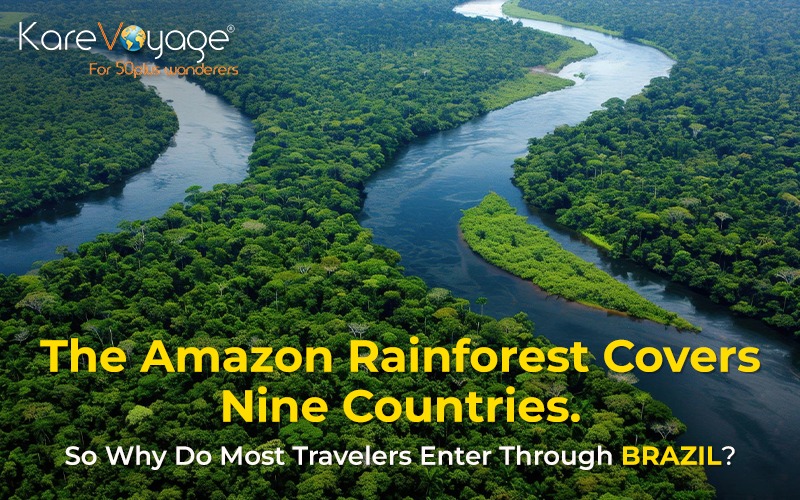
The Amazon Rainforest stretches across nine countries – Brazil, Peru, Colombia, Bolivia, Ecuador, Venezuela, Guyana, Suriname & French Guiana. Yet, most travellers still choose Brazil when they plan to visit the Amazon
At first, it seems obvious. Brazil has the largest share of the rainforest. But that alone doesn’t explain why it has become the world’s most popular gateway to the Amazon. After all, Peru offers incredible biodiversity, Colombia has untouched rainforest & Ecuador provides easier access to parts of the Amazon Basin.
The real answer has very little to do with the rainforest’s size alone. Geography, history, transportation, conservation, river systems & decades of infrastructure development have all shaped Brazil into the preferred starting point for Amazon expeditions. Once you understand these factors, Brazil’s popularity starts to make perfect sense.
Why do most travelers enter the Amazon through Brazil? 6 reasons that explain everything
The Amazon may span 9 countries but nearly 60% of it lies inside Brazil
The Amazon is the world’s largest rainforest but it isn’t confined to only one nation. It covers approximately 6.7 million square kms stretching across nine South American territories.
Brazil alone contains nearly 60% of the entire Amazon Rainforest – while Peru accounts for around 13%, Colombia about 10% and the remaining area is shared by six other countries.
This geographical distribution matters because a larger rainforest naturally supports:-
- longer navigable river systems
- more protected forests
- greater wildlife diversity across different habitats
- larger indigenous territories
- more opportunities for scientific research and ecotourism
However, size alone doesn’t automatically make Brazil the preferred choice for travellers.
For example, Peru’s Amazon is regarded as one of the most biodiverse regions on Earth – particularly around Manu National Park and Tambopata National Reserve. Ecuador’s Yasuni National Park is also famous among wildlife researchers. If biodiversity were the only deciding factor – visitors would be spread far more evenly across all Amazon countries.
Clearly, something else has influenced travel patterns over the decades. That brings us to geography – an advantage Brazil inherited long before modern tourism even existed.
Geography gave Brazil an advantage long before tourism existed
Long before anyone thought about Amazon tourism – Brazil had already gained a geographical advantage. Almost the entire Amazon River system eventually flows eastward through Brazil before emptying into the Atlantic Ocean. Along the way, thousands of tributaries including the Rio Negro, Solimoes, Madeira, Tapajos and Xingu create one of the world’s largest natural transportation networks.
This matters because much of the Amazon has very few roads. Even today, rivers remain the primary way to reach many forests and communities.
As a result, Brazil naturally developed:-
- better river connectivity across the rainforest
- easier access to remote reserves and wildlife areas
- larger expedition cruises and research vessels
- more practical movement between lodges and indigenous communities
Another geographical advantage is Brazil’s Atlantic coastline. Historically, ships arriving from Europe reached Brazil’s ports long before inland Amazon settlements developed elsewhere. Over centuries, this helped establish trade routes that naturally expanded towards the Amazon Basin.
But geography alone cannot turn a place into the world’s leading tourism gateway. People also need airports, accommodation, guides & reliable infrastructure.
Manaus became the Amazon’s gateway because history worked in its favour
If there is one city responsible for making Brazil the world’s gateway to the Amazon, it is Manaus. Located deep inside the rainforest – the city grew rapidly during the Amazon Rubber Boom in the late 19th century. As natural rubber became one of the world’s most valuable resources, Manaus developed ports, warehouses, public buildings & transport systems that few Amazon cities could match.
Although the rubber boom eventually ended, the infrastructure remained. Today, Manaus offers nearly everything first-time Amazon visitors need:-
- an international airport with regular flight connections
- one of the Amazon’s busiest river ports
- experienced naturalist guides and expedition operators
- research institutes, hospitals and emergency facilities
- jungle lodges, eco-resorts & river cruises
It also provides easy access to iconic experiences like the Meeting of the Waters – where the dark waters of the Rio Negro and the sandy-coloured Solimoes River flow side by side for several kilometres without mixing immediately. The reason lies in differences in – water temperature, density and flow speed – creating a spectacle that continues to intrigue scientists and travellers alike. This combination of history, accessibility and logistics has made Manaus the starting point for countless Amazon expeditions.
Still, another question remains. If Brazil has become so popular, what makes the experience itself different from visiting the Amazon elsewhere?
Brazil offers Amazon experiences that are difficult to replicate elsewhere
One reason travellers continue choosing Brazil is the sheer variety of experiences available from a single region.
Within a relatively short distance from Manaus – visitors can explore flooded forests, blackwater rivers, indigenous communities, wildlife reserves and dense jungle trails without constantly changing locations.
Some of the Amazon’s most memorable experiences include:-
- pink Amazon river dolphins, one of the world’s few freshwater dolphin species.
- three-toed sloths resting high in the forest canopy
- toucans, macaws and countless bird species that make the Amazon one of the world’s premier birdwatching destinations
- black caimans during guided night safaris
- giant water lilies and flooded igapo forests that transform dramatically with changing water levels
Another fascinating aspect is that the rainforest changes dramatically throughout the year. During the wet season – rivers can rise by 10 to 15 metres allowing boats to enter flooded forests that remain inaccessible during the dry season. As water levels recede, animals gather along riverbanks & exposed beaches making them easier to spot.
This means 2 people visiting the same lodge at different times of the year may have completely different experiences.
Brazil has also invested heavily in community-based tourism over the past few decades. Many eco-lodges now work directly with indigenous & riverside communities allowing visitors to learn about traditional fishing methods, medicinal plants, forest survival techniques & sustainable living practices. These experiences are carefully managed to respect local cultures while supporting conservation & livelihoods.
It is this combination of – geology, biodiversity and cultural interaction – that makes the Brazilian Amazon feel much larger than a simple wildlife destination.
Decades of conservation and tourism planning also played a major role
Finally, Brazil’s success isn’t only about geography or infrastructure. It is also the result of decades of conservation and planning.
Over the years, Brazil has established one of the largest networks of protected rainforest areas in the world. National parks, biological reserves, extractive reserves & sustainable development reserves now protect millions of hectares of rainforest. Together they preserve habitats for thousands of plant & animal species while allowing carefully regulated ecotourism in selected regions. These conservation efforts have helped preserve wildlife while allowing responsible tourism to grow
Today, many Amazon lodges:-
- work closely with indigenous communities
- follow sustainable tourism practices
- limit visitor numbers in sensitive ecosystems
- employ trained local naturalists
- support conservation and scientific research
For travellers, this creates a chance to experience one of Earth’s richest ecosystems – while helping protect it for future generations.
The other Amazon countries are extraordinary too but they offer a different kind of journey
By now, it is clear that Brazil didn’t become Amazon’s main gateway by chance. Still, this doesn’t mean the rest of the Amazon is any less spectacular.
Each country offers something unique. The difference lies in how easily travellers can reach the rainforest & the kind of experience they can expect once they’re there
Here’s how they compare:-
- Peru – the city of Iquitos is the main gateway to the upper Amazon and is famous for incredible biodiversity around reserves like Manu and Tambopata. However, Iquitos has no road connection to the rest of Peru – so most visitors arrive by domestic flight. Many expeditions here are designed for birdwatchers, researchers and travellers seeking a more remote jungle experience
- Colombia – the Amazon around Leticia rewards travellers looking for untouched rainforest but transport options, accommodation and organised tourism remain more limited than in Brazil
- Ecuador – its Amazon is relatively easy to reach from Quito especially around Yasuni National Park. While wildlife viewing is exceptional, the rainforest covers a much smaller area making the overall experience more compact
- Bolivia, Guyana, Suriname and French Guiana – these countries also protect vast stretches of rainforest but tourism infrastructure is still developing in many regions. As a result organised expeditions, river cruises and visitor facilities are comparatively fewer
None of these destinations is “better” or “worse.” They simply cater to different travel styles.
For many first-time visitors and particularly those who value smoother logistics, experienced naturalist guides, well-established lodges and a wider range of rainforest experiences – Brazil naturally becomes the easiest and most feasible place to begin exploring the Amazon.
Why Brazil continues to be the world’s favourite gateway to the Amazon
The answer, ultimately, isn’t that Brazil has the biggest share of the Amazon Rainforest. Over centuries, geography, history, river navigation, conservation, infrastructure and carefully developed ecotourism have all come together in one place. While every Amazon country offers something unique – Brazil provides the easiest balance of accessibility, biodiversity, authentic rainforest experiences and visitor support making it the preferred starting point for many
first-time travellers especially senior citizens who value comfort alongside adventure.
At KareVoyage, we believe extraordinary journeys begin with understanding the destination. With more than 10 years of experience designing exemplary senior citizen travel packages – we have earned the trust of countless travellers through our thoughtfully curated itineraries, expert planning and dedicated on-ground support. Our holiday packages for senior citizens from India are carefully crafted to combine safety, comfort and enriching experiences.
When you travel with us – you get to experience Brazil with the confidence that every detail has been planned by a team that understands the needs of senior travellers.