
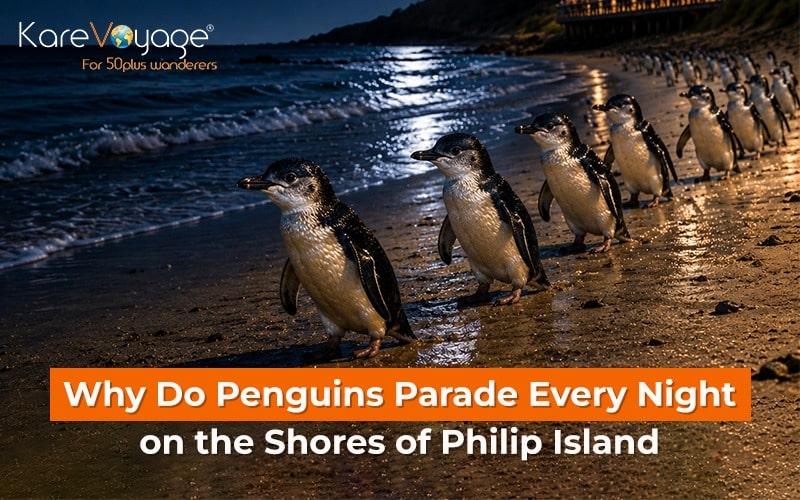
Every evening on Phillip Island, a fascinating sight can be seen. As daylight fades and the beach grows quieter – tiny penguins begin emerging from the ocean in groups. They pause, look around, gather together & then start waddling towards the dunes and burrows inland.
To visitors, it looks almost like a carefully organised procession. In reality, there is no parade at all.
What people call the “Penguin Parade” is actually a highly evolved survival behaviour that has helped Little Penguins survive for thousands of years. The more scientists study these birds – the clearer it becomes that almost every step of this nightly journey is linked to survival, reproduction and protection from predators.
So why do they do it every night? The answer lies in a combination of biology, instinct, geography & evolution.
Why do little penguins return to land every night
Little Penguins spend most of their day at sea. They can travel tens of kilometres searching for prey. However, unlike many marine animals – they cannot live entirely in the water.
Every evening they must return to land because their burrows serve several critical purposes:-
- Protecting eggs and chicks – Little Penguins lay their eggs in small holes in the ground. These holes keep their babies safe from danger & bad weather
- Maintaining pair bonds – Many Little Penguins return to the same mate year after Returning home each evening helps maintain these breeding partnerships
- Rest and energy conservation – A protected burrow allows penguins to recover after spending an entire day swimming and hunting
Researchers have observed that during breeding season – adults often return carrying food for chicks waiting in the burrow. In simple terms, if penguins stopped returning to land every night, their chances of successfully raising the next generation would drop.
But this raises another question that if returning home is so important, why don’t they come ashore during daylight?
Why do penguins come ashore after sunset on ‘Phillip Island’
One of the most fascinating discoveries from penguin behaviour studies is that the timing of the parade is not random. Little Penguins usually wait until sunset because darkness gives them a survival advantage.
During the day – penguins crossing open beaches are vulnerable to predators. Historically, large seabirds & raptors could easily spot a lone penguin moving across exposed sand. Arriving after sunset reduces visibility & lowers the risk of attack.
Scientists have found that penguins often adjust their arrival times throughout the year based on sunset patterns.
Their behaviour is closely linked to:-
- light levels rather than clock time
- seasonal daylight changes
- weather conditions
- predator activity
This is why the parade starts earlier in winter and later in summer. Many visitors are surprised to learn that the penguins do not immediately rush onto the beach after reaching shore. Instead, another interesting behaviour takes place.
Why do penguins gather offshore before coming onto the beach
Before coming ashore, penguins often gather in groups just beyond the breaking waves. Scientists call this behaviour “rafting.” For several minutes and sometimes longer, dozens of penguins may float offshore together before any of them make a move.
Why? Because there is safety in numbers. Rafting helps penguins:-
- assess danger on the beach before landing
- reduce the risk faced by any individual bird
- build confidence through group behaviour
- increase the chances of detecting predators
Researchers studying Phillip Island have repeatedly observed that once a few penguins begin moving ashore, many others quickly follow. This collective behaviour is not unique to Phillip Island, but the scale at which it can be observed here makes it one of the best places in the world to understand how penguins think and behave.
Why is ‘Phillip Island’ one of the best places in the world for Little Penguins
The final piece of the puzzle is geography. The Penguin Parade happens so reliably on Phillip Island because the island provides exactly what Little Penguins need to survive.
Phillip Island Offers Ideal Feeding and Nesting Conditions
Several natural advantages come together here:-
- rich feeding waters nearby mean adults do not need to travel excessive distances to find food
- suitable sandy terrain allows penguins to create stable burrows
- coastal vegetation provides additional shelter and protection
- long-term conservation efforts have helped preserve breeding habitats
Conservation efforts have helped protect the penguin colony
Today, Phillip Island supports one of the largest Little Penguin colonies in the world. Conservation programs, habitat restoration & predator management have played a major role in protecting this unique ecosystem.
When you understand the science behind the parade – the experience becomes far more meaningful. You realise that what appears to be a charming evening walk is actually the result of thousands of years of evolution, adaptation & survival.
For travellers who enjoy learning the stories behind the places they visit – experiences like this often become the highlight of a journey. This is why we, at Karevoyage, specifically include Phillip Island in our international tour packages for senior citizens for exploring Australia. Likewise, people often discover that wildlife experiences abroad offer a completely different perspective on nature and conservation.
For those considering senior citizen tours from India to Australia ‘Phillip Island’ stands out as one of those rare places where understanding the science behind what you are seeing makes the experience even more memorable.
The next time you watch hundreds of Little Penguins emerging from the sea – remember that you are not watching a performance. You are witnessing one of nature’s most remarkable nightly survival rituals.